October 22, 2026
Sponsorship Transfer in Saudi Arabia: Qiwa Process, Fees and Status Checks

Content Writer

Moving an expatriate employee from one Saudi employer to another takes more than agreeing a start date. The new employer has to start the right digital transfer request, the employee has to respond where required, and the system has to validate the request before employment records change.
Sponsorship transfer in Saudi Arabia, often called iqama transfer or naqal kafala, is now handled mainly through the Ministry of Human Resources and Social Development (MHRSD) and the Qiwa platform. This guide explains the process for private-sector employers, how to check transfer status, what the fees cover and how HR can plan a compliant handover.
Every approval, with a clear audit trail.
Elevatus automates approvals for job requisitions, offers and candidate onboarding, ensuring all approvals are obtained from the necessary stakeholders while maintaining a clear audit trail.
Request a demoKey takeaways:
- The new employer starts a sponsorship transfer in Qiwa. It must meet MHRSD’s conditions, including a valid commercial registration, valid work permits, wage-protection compliance and enough transfer credit.
- The current employer’s consent is not always needed. MHRSD’s freedom-of-movement route lets an eligible resident employee move to a new employer without approval, subject to conditions. The current employer is notified.
- The MHRSD employee-transfer service is free and immediate. The SAR 2,000, 4,000 and 6,000 charges often quoted online apply to domestic-worker transfers through Absher, not to private-sector employees.
What Is Sponsorship Transfer in Saudi Arabia?

Sponsorship transfer means moving a non-Saudi worker’s employment services from one Saudi employer to another. MHRSD’s English-language services describe it as “employee transfer” or “transfer of services”, and the request runs through Qiwa without a visit to the ministry.
It is different from bringing in a new overseas hire, which needs a work visa and a first work permit in Saudi Arabia. It is also more than an internal HR record update, because the official employment and work-permit records change when the transfer completes.
“Transferable iqama” is informal shorthand. A valid residence permit alone does not make a worker eligible. The worker’s contract status, the transfer route and the receiving establishment’s standing all matter.
Who Is Eligible for a Saudi Sponsorship Transfer?

Eligibility depends on both the receiving employer’s compliance position and the employee’s circumstances. HR should check the live Qiwa service rules for each worker, rather than assuming every employee can transfer under the same conditions.
What Are the Requirements for Employers to Transfer Sponsorship in Saudi Arabia?
MHRSD’s expatriate-transfer service lists these establishment-level conditions:
- A valid commercial registration.
- An establishment whose status is “existing”.
- Valid work permits across all establishments under the unified number.
- Compliance with the Wage Protection System.
- Other entities under the same unified number in at least the medium green Nitaqat band (or very small green for small category A businesses).
- Enough establishment credit for the transfer.
The service is fully automated, so these checks run in the system. Because the conditions tie closely to localization, assess each incoming hire against your Saudization compliance strategy before you submit.
Official source: MHRSD, Request for transfer of expatriate workers
What Employees Must Confirm Before a Saudi Sponsorship Transfer
The employee should confirm the offer, identity details, current employment relationship, contractual notice obligations and any Qiwa notifications.
Moving without the current employer’s approval is conditional, not universal. Contract expiry, employment history, absence records and other exceptions can change which route applies.
How to Transfer Sponsorship in Saudi Arabia Through Qiwa

For a standard private-sector move, the receiving establishment starts the request in Qiwa, the MHRSD labor platform, and the employee completes the acceptance step. Screen labels can change, so treat the sequence below as MHRSD’s published process rather than a screen-by-screen guide.
| Stage | Responsible party | Action |
| 1. Confirm readiness | New employer | Check establishment eligibility, the vacancy and the employment terms. |
| 2. Create the request | New employer | Sign in to the Qiwa establishment account, choose the employee transfer service, select the receiving establishment and add the worker’s details. |
| 3. Add the contract or offer | New employer | Add an employment contract for each worker, or send the digital job offer the chosen route requires. |
| 4. Review and respond | Employee | Open the Qiwa individual account and accept or reject the offer. |
| 5. Complete system checks | Qiwa and relevant parties | Let eligibility checks and any notice or approval steps finish. |
| 6. Confirm completion | Employer and employee | Check the updated employment and work-permit record before treating the move as final. |
Employer Transfer Route vs Freedom-of-Movement Route
Qiwa offers two main ways to move an expatriate employee between private-sector employers. MHRSD lists the freedom-of-movement service with a release date of 8 September 2026.
| Feature | Employer transfer request | Freedom-of-movement transfer |
| Who starts it | New employer, in its Qiwa establishment account | New employer, by sending a job offer through Qiwa |
| Current employer’s role | Part of the transfer request | Notified of the request, approval not required |
| Employee’s role | Confirms the move where prompted | Accepts or rejects the offer in Qiwa |
| Outcome | Services move to the new establishment | Data is updated and a new work permit is issued |
| MHRSD fee | Free | Free |
Official source: MHRSD, Transfer of services from another employer (Freedom of movement)
How to Check Sponsorship Transfer Status in Saudi Arabia

To check sponsorship transfer status, sign in to the relevant Qiwa account and open the employee transfer request or received job offer. Review its current stage, any outstanding action and whether the new employer’s records show the transfer as complete.
If the record is missing, ask the receiving employer for the request details and confirm that the correct employee identity was entered.
Checking Status From the Employee’s Qiwa Account
Open Qiwa’s services or employment notifications and review the pending transfer or offer. A request awaiting acceptance is not complete, so revisit the record after responding.
If the status is unclear, use Qiwa’s official support channel rather than a third-party “nakal kafala check” website.
Checking Status From the Employer’s Qiwa Account
The HR administrator should open the transfer request in the establishment account and check whether it needs corrections, acceptance or further processing. Keep the request number and timestamps in the personnel file, and cross-check the resulting work-permit and residence records through your authorized government channels.
For high-volume transfers, a structured handover checklist saves more time than repeated manual status checks. It is one reason Saudi HR teams invest in HR digital transformation in KSA.
Can Sponsorship Be Transferred After Iqama Expiry?

Sometimes. An expired iqama does not give a blanket right to transfer, and it does not always rule a transfer out. The outcome depends on the worker’s status, the transfer service used and whether an exceptional route applies.
On 18 September 2025, MHRSD launched an initiative through Qiwa to regularize workers recorded as “absent from work”. It requires the new employer to pay any outstanding work-permit fees, and the worker must have completed at least 12 continuous months in the Kingdom before work stopped or the contract ended. Official source: MHRSD, initiative to regularize absent workers
That initiative should not be read as a rule for all expired iqamas. Resolve permit and residency issues before promising a joining date, and keep Qiwa records current, since undocumented records are a common cause of the compliance gaps described in this GCC HR compliance guide.
Does a Sponsorship Transfer Require the Current Employer’s Consent?

Not always. MHRSD’s freedom-of-movement service lets an eligible resident employee transfer to a new employer without the current employer’s approval, subject to the applicable regulations and conditions. The current employer is notified of the request.
Other situations may follow different contractual or administrative rules. Confirm the actual Qiwa route before assuming consent is either required or unnecessary. Where both employers agree, some HR teams also keep a signed no objection certificate on file, but it does not replace the Qiwa transaction.
How Much Are Sponsorship Transfer Fees in Saudi Arabia?

MHRSD lists both its employee-transfer service and its freedom-of-movement service as free. That covers the ministry service itself, not every government, residency or administrative cost linked to the move.
The SAR 2,000, SAR 4,000 and SAR 6,000 figures often quoted online come from an Absher guide for the first, second and third transfers of a domestic worker. They are not a fee schedule for private-sector employee transfers in Qiwa. Official source: Absher services guide
| Fee or cost | What the official source says |
| MHRSD employee-transfer e-service | Listed as free |
| MHRSD freedom-of-movement service | Listed as free |
| Domestic-worker transfer through Absher | SAR 2,000 (first), SAR 4,000 (second), SAR 6,000 (third) |
| Work-permit, residence or outstanding charges | Check the official payment notice for the specific transaction |
When you budget for the hire, compare the full employment cost, including social insurance, with tools such as this GOSI calculator.
From requisition to onboarding, in one place.
Elevatus manages recruitment end to end, from job requisition and candidate attraction to screening, video interviewing and onboarding, in a single, unified and governed system.
Request a demoHow Long Does Sponsorship Transfer Take?

There is no single end-to-end timeline. MHRSD lists the electronic services as immediate, but that does not mean employer actions, the worker’s response, contractual notice periods and record updates all finish instantly.
The real duration depends on the route and any unresolved requirements. Set the start date only after the official status confirms the transfer is complete.
Employer Checklist for a Smooth Sponsorship Transfer

Large employers should treat sponsorship transfer as a controlled employment transition, not just a Qiwa form. A documented process cuts rework and keeps recruitment, legal, payroll and onboarding teams working from the same employee record.
| Before the request | During the request | After confirmation |
| Verify the receiving entity and job terms | Track the Qiwa request and the employee’s response | Confirm the official work-permit and employment update |
| Check Nitaqat and wage-protection status | Record exceptions and deadlines | Align payroll, system access and onboarding |
| Review the contract and joining-date assumptions | Escalate mismatched identity or status data | Keep the audit trail and signed documents |
For large organizations hiring international talent in Saudi Arabia, managing visa allocations, recruitment approvals, and onboarding across multiple departments can quickly become complex.
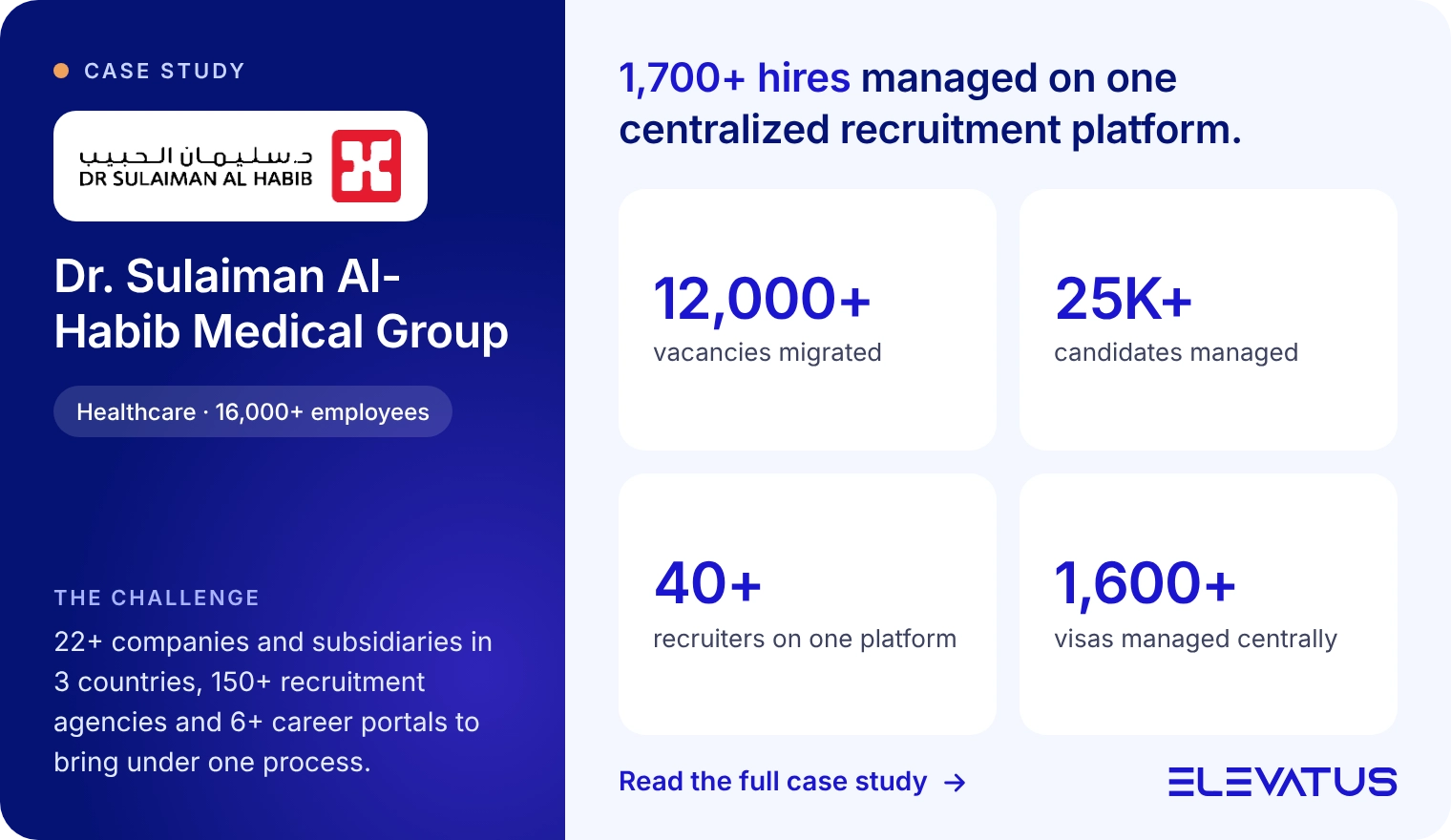
Dr. Sulaiman Al-Habib Medical Group is a strong example of how centralized recruitment technology helps manage this complexity at scale. Operating across 22+ companies and subsidiaries, the healthcare group leveraged Elevatus to centralize the management of more than 1,600 visas, support 1,700+ successful hires, and manage over 25,000 candidates through a unified recruitment platform.
As an Agentic AI Hiring Operating System, Elevatus helps enterprises streamline international recruitment through agentic AI candidate screening, automated approval workflows and coordinated onboarding. This gives HR teams greater visibility and control over the hiring process while keeping official visa and sponsorship transfer procedures within the relevant Saudi government systems.
For organizations managing large expatriate workforces, the value lies in connecting recruitment and onboarding within one structured hiring workflow.
Compare hiring operating systems in Saudi Arabia to see how they structure that work.
Common Sponsorship Transfer Problems and What HR Should Do

- The request cannot be submitted: review establishment eligibility, employee identifiers and whether the selected service matches the worker’s status.
- The employee cannot see the offer: confirm the Qiwa account and request details with the receiving employer.
- The transfer is stuck as pending: identify whose action is outstanding before opening a duplicate request.
A separate risk appears when a recruiting team treats candidate selection as permission to start work. Hiring approval, the employment contract and completion of the official transfer are distinct milestones.
An agentic AI hiring platform can make those milestones visible internally, but the authoritative transfer decision and employee record stay with the designated Saudi government services.
According to the General Authority for Statistics’ Register-based Labour Market Statistics for Q2 2026, 10,696,518 non-Saudi employees were registered in Saudi Arabia’s private sector, about 80% of all private-sector social insurance participants (preliminary GOSI data). That is the workforce Qiwa’s sponsorship transfer rules apply to.
Final Thoughts on Sponsorship Transfer in Saudi Arabia

A successful sponsorship transfer in Saudi Arabia requires more than completing the necessary paperwork. It depends on choosing the correct transfer route, meeting eligibility requirements, securing the appropriate approvals, and keeping the employee informed throughout the process.
For enterprises managing multiple hires, the challenge is ensuring that recruitment, documentation, sponsorship transfer coordination, and onboarding work together without unnecessary delays. When responsibilities are unclear or information is scattered across systems, even a straightforward transfer can disrupt hiring timelines and the employee experience.
The key is to establish a structured process with clear ownership, accurate documentation, and visibility at every stage—from the initial hiring decision to the employee’s first day.
Is Your Hiring Process Ready for a Smoother Transition?
Managing sponsorship transfers is only one part of bringing international talent into your organization. The bigger challenge is keeping recruitment moving while coordinating approvals, tracking candidate progress, and preparing new hires to join your workforce.
Elevatus, the Agentic AI Hiring Operating System, helps enterprises bring greater structure, automation, and visibility to the hiring journey.
With Elevatus, HR teams can streamline recruitment workflows, accelerate candidate screening with agentic AI, centralize hiring approvals, and coordinate onboarding across departments and locations. This helps organizations maintain continuity throughout the hiring process while managing official sponsorship transfer requirements through the relevant Saudi government platforms.
Whether you’re hiring across multiple business units or scaling your workforce in Saudi Arabia, Elevatus helps your team stay organized, reduce administrative bottlenecks, and deliver a more connected hiring experience.
Ready to simplify enterprise hiring in Saudi Arabia?
Request a free demo to discover how Elevatus can help you streamline recruitment, automate workflows, and prepare new hires for success.
Frequently Asked Questions About Sponsorship Transfer in Saudi Arabia
How Do I Check Sponsorship Transfer Status in KSA?
Open the request in your Qiwa individual or establishment account, check for any pending acceptance or action, and confirm the official record has been updated. If it is unclear, contact the receiving employer or Qiwa support.
Can I Transfer Sponsorship if My Iqama Has Expired?
Possibly, depending on the transfer route and your employment status. Expiry alone does not settle eligibility, so the receiving employer should check current Qiwa and MHRSD conditions and any outstanding permit issues.
Can I Transfer Sponsorship Without My Current Employer’s Approval?
Yes, if you are eligible for MHRSD’s freedom-of-movement route, which allows a transfer without current-employer approval subject to conditions. The current employer is notified of the request.
Who Pays the Sponsorship Transfer Fee?
MHRSD lists its employee-transfer services as free. Any other charges, such as outstanding work-permit fees, should be checked against the official payment notice, the law and the employment contract.
Is an Iqama Transfer the Same as a Domestic-Worker Transfer?
No. Private-sector employee transfers run through Qiwa, while domestic-worker transfers use Absher and carry separate published fees. Always confirm the worker category before starting a sponsorship transfer.
Turn top talent to employees fast
Hire, assess, onboard and manage top talent for every job. See how Elevatus streamlines everything; from acquire to new hire.
Request a demoAuthor
Kiran Kazim is a Senior SEO Content Specialist at Elevatus with more than eight years of experience writing about HR and technology. With a background in HR, she writes about talent acquisition, recruitment technology and workforce compliance in the GCC, using primary sources such as official government guidance and platform data.
Don't miss a thing!
Stay one step ahead. Subscribe and get the latest updates, news, and insights from Elevatus straight to your inbox.