October 22, 2026
Minimum Wage in Saudi Arabia in 2026: What Employers Need to Know

Content Writer

A multinational employer setting salaries in Riyadh may see a SAR 4,000 figure, an expatriate offer below that amount and a separate salary rule for a localized profession. Which one applies depends on the worker’s nationality, the occupation and what the threshold is for.
The minimum wage in Saudi Arabia is not one universal salary floor for every worker. The widely cited SAR 4,000 is the monthly wage a Saudi employee needs to count as one full worker in Nitaqat, the Saudization program. This guide explains how that rule works, what applies to expatriates and how HR teams can set compliant salary offers.
Stop hiring reactively. Start hiring intelligently.
See how Elevatus manages recruitment end to end, from job requisition and candidate attraction to screening, video interviewing and onboarding.
Request a demoKey takeaways:
- SAR 4,000 is a Nitaqat counting rule, not a universal minimum wage. Under Ministerial Decision 61706, a Saudi employee on at least SAR 4,000 a month counts as one worker, SAR 3,000 to under SAR 4,000 counts as half, and below SAR 3,000 does not count.
- There is no single minimum wage for expatriates. Expat pay is set by the documented employment contract and any occupation-specific rules, and the Wage Protection Program checks it is paid on time and in full.
- The wage definition changes the result. Nitaqat uses the salary registered with GOSI, overtime is based on the basic wage, and enforceable Qiwa contracts cover basic wage plus housing, transport and other cash allowances.
What Is the Minimum Wage in Saudi Arabia in 2026?

There is no single statutory minimum monthly wage that applies to every Saudi and expatriate private-sector employee. The SAR 4,000 figure is the monthly wage at which an eligible Saudi employee counts as one full worker in Nitaqat. It is not a minimum for foreign workers, domestic workers or every job category.
| Worker or rule | How to read the amount |
| Saudi national in Nitaqat | SAR 4,000 or more counts as one worker, SAR 3,000 to under SAR 4,000 counts as half, below SAR 3,000 does not count. |
| Expatriate private-sector worker | No universal salary floor. The documented contract and any occupation-specific rules apply. |
| Overseas Filipino worker (OFW) | No single Saudi-wide OFW wage. Check the Saudi contract and current Philippine deployment standards. |
| Domestic worker | A separate regulatory and contracting framework applies. |
| Localized professions | A profession-specific localization decision may set its own minimum salary for counting Saudis. |
Because salaries also have to fit internal grades, many employers build these rules into their pay scale in Saudi Arabia rather than handling them case by case.
How the SAR 4,000 Nitaqat Wage Threshold Works
Nitaqat is Saudi Arabia’s establishment classification program for workforce localization. The salary of each Saudi employee decides how much that person counts toward the establishment’s Saudization percentage, which in turn sets its Nitaqat band. It does not set the lawful minimum salary for every individual.
Full, Half and Zero Counting Bands
Ministerial Decision 61706, issued on 19 November 2020, sets these bands. The decision defines the monthly wage as the salary subject to GOSI social insurance contributions.
| Monthly wage of a Saudi employee | How the employee counts in Nitaqat |
| SAR 4,000 or more | One worker |
| SAR 3,000 to under SAR 4,000 | Half a worker |
| Below SAR 3,000 | Not counted |
The same wage bands apply to non-Saudi workers treated as Saudis for Nitaqat purposes, such as Gulf nationals. Official source: MHRSD, Ministerial Decision 61706
Special Categories With Different Counting Rules
The decision also sets separate rules for some groups. A part-time Saudi worker counts as half a worker with a GOSI wage of at least SAR 3,000, and a worker on the flexible work system counts as a third after 168 hours at a minimum of SAR 25 an hour.
A Saudi employee with a disability counts as four workers with a GOSI wage of at least SAR 4,000, subject to percentage caps. Students, part-time workers and released prisoners have their own caps and conditions.
Why Salary and Saudization Compliance Are Not the Same
An employer can meet a contractual wage obligation and still find the salary does not deliver the expected localization credit. Meeting a counting threshold also does not prove compliance with every labor, licensing or payroll rule. Review these questions separately, and adapt hiring plans with these 2026 Saudization compliance strategies.
Is There a Minimum Wage in Saudi Arabia for Expats?

No single minimum wage applies to every expatriate employee. The SAR 4,000 Nitaqat threshold is not a salary floor for expatriates. Expatriate pay is set by the documented employment contract, subject to Saudi labor requirements and any role-specific rules.
That does not permit underpaying, paying late or ignoring contractual benefits. Expat salaries are monitored through the same Wage Protection Program as Saudi salaries.
Contractual Wages and Employee Protections
A documented contract should state the agreed basic wage and each allowance. Make sure the offer letter, the signed Qiwa contract and payroll records all show the same figures, because those terms drive payroll, wage disputes and statutory calculations.
Hiring from overseas adds steps beyond salary, from the work visa to the work permit in Saudi Arabia, so agree the pay terms before those applications start.
Minimum Wage in Saudi Arabia for OFWs
For overseas Filipino workers (OFWs), salary can also depend on Philippine overseas-employment documents and worker-category standards. There is no single Saudi minimum wage for every OFW occupation, so confirm current deployment and contract requirements with the Philippine authorities before issuing an offer.
What Is the Difference Between Basic Wage and Actual Wage in Saudi Arabia?

Under the Saudi Labor Law, the basic wage is everything paid to a worker under the employment contract, plus periodic increments. The actual wage is the basic wage plus other due increments, such as commissions, effort or risk allowances, cost-of-living increments and contractual grants or rewards.
The difference matters because each entitlement uses a specific wage base. Official source: MHRSD labor education FAQs
| Pay component | Practical meaning |
| Basic wage | The core contractual wage, plus periodic increments. |
| Housing allowance | Extra pay where the contract provides it, in cash or in kind. |
| Transport allowance | A contractual benefit or payment where it applies. |
| Actual wage | Basic wage plus commissions, effort or risk allowances and other due increments. |
| Net pay | What the employee receives after permitted deductions. |
For example, an offer of SAR 5,000 made up of SAR 3,500 basic salary and SAR 1,500 in allowances is not the same as SAR 5,000 basic salary. To see what an offer really costs once social insurance is added, use a GOSI calculator.
How Saudi Wage Protection Works Through Mudad
The Wage Protection Program, launched in 2013, monitors wage payments for all private-sector workers, Saudi and expatriate. Through the Mudad platform it checks in real time that establishments pay wages on the scheduled dates and in the amounts agreed in documented contracts.
It is a payroll-control obligation, not evidence of a universal minimum wage. The core duty is to pay the agreed wage accurately and on time, with records that match the employment contract.
Documented Qiwa Contracts and Wage Disputes
Since October 2025, MHRSD and the Ministry of Justice have rolled out, in phases, an initiative that makes a documented Qiwa employment contract an enforceable instrument through the Najiz platform. Its wage item covers the basic wage, housing allowance, transport allowance and other cash allowances, and it is checked against Mudad records.
If an employer delays the full wage for 30 days after the due date, or pays only part of it for 90 days, the worker can apply for enforcement directly in Najiz without filing a labor lawsuit. The employer then has five days to object or pay. Official source: MHRSD, enforceable documented contract initiative
Keeping those Qiwa records accurate is a recurring theme of this GCC HR compliance guide.
Real-time recruitment KPIs on role-based dashboards
Elevatus lets you create role-based dashboards for recruiters, HR leaders, hiring managers and executives with real-time recruitment KPIs, and export data as CSV for Excel and Power BI.
Request a demoHow Overtime, Leave Pay and Other Benefits Are Calculated in Saudi Arabia

Salary compliance goes beyond the monthly figure in an offer letter. Employers must calculate overtime, leave pay and end-of-service benefits under the Saudi Labor Law and the employee’s actual contract, and each entitlement may use a different wage base.
Overtime Pay Under Article 107
Under Article 107 of the Labor Law, the employer pays overtime at the hourly wage plus 50% of the basic wage. With the worker’s consent, the employer may give paid compensatory leave instead of overtime pay. All hours worked on public holidays count as overtime. Official source: MHRSD, working hours and overtime
Annual Leave, Sick Leave and Vacation Pay
Calculate leave entitlements from the current law, the employee’s service history and the right wage definition. A reliable workflow records accruals, approvals, paid periods and final settlement figures.
Sick leave follows its own paid, partly paid and unpaid tiers, set out in this guide to sick leave in Saudi Arabia. None of these should be confused with a national minimum wage figure.
How Enterprise HR Teams Set Compliant Salary Offers in Saudi Arabia
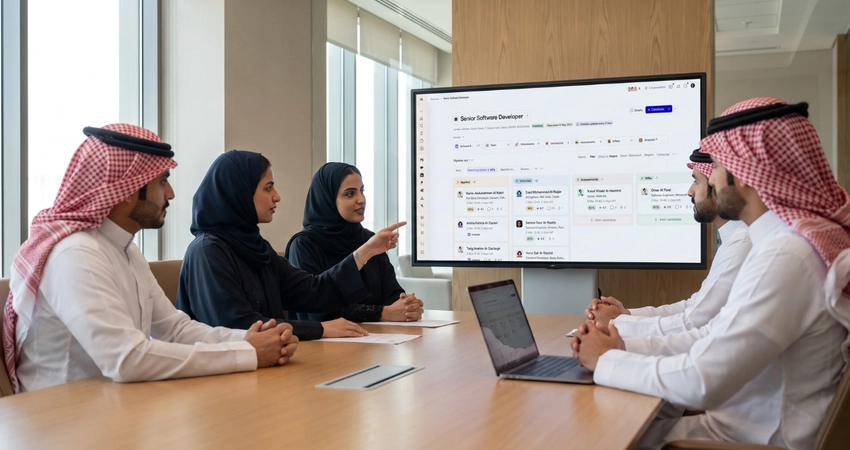
For enterprises hiring across Saudi regions and job families, salary governance is a repeatable control process. It starts before a vacancy is approved and continues through contract signing and payroll setup.
Check the Applicable Rule Before Publishing a Vacancy
Identify the worker’s nationality, occupation, sector, work location and employment category, and check whether a profession-specific localization decision applies. Then test the proposed salary against internal pay bands, the Nitaqat counting bands and any cross-border recruitment rules, using a structured Saudi recruitment workflow.
Connect the Offer, Contract and Payroll Record
Use the same approved salary components in the job requisition, the candidate offer, the signed Qiwa contract and payroll onboarding. Reconcile late changes and keep an approval trail to avoid disputes caused by different definitions of “salary”.
Keep Human Review in the Hiring Process
Elevatus, the Agentic AI Hiring Operating System, supports structured recruitment, agentic AI candidate screening, assessments and onboarding. It helps teams organize hiring decisions and paperwork through enterprise recruitment workflows and approvals, but it does not replace Qiwa, Mudad or legal review. People should confirm pay, eligibility and compliance before an offer is final.
According to the Ministry of Human Resources and Social Development’s Wage Protection Program update, more than 1 million establishments, 94% of the private sector, were registered on the Mudad platform by the end of 2025, with wages for over 10 million workers documented and compliance above 85%. Salary rules in Saudi Arabia are now checked against real payroll data, not just contracts.
Final Thoughts on the Minimum Wage in Saudi Arabia

Understanding the minimum wage in Saudi Arabia isn’t just about knowing a number. It’s about knowing which rules apply to your workforce and how those rules affect hiring decisions.
A minimum wage requirement, a Saudization salary threshold, and an agreed contractual salary aren’t necessarily the same thing. Confusing them can lead to inaccurate hiring budgets, unexpected workforce planning challenges, and avoidable payroll disputes.
The good news? Getting it right starts long before an employee’s first paycheck. By understanding salary requirements early, aligning recruitment with workforce budgets, and maintaining clear employment records, organizations can make better hiring decisions from the start.
Because successful workforce planning isn’t just about filling positions. It’s about hiring the right people with the right processes in place.
Ready to Take the Guesswork Out of Workforce Planning?
Managing recruitment across multiple departments, locations, and job categories can be challenging, especially when salary expectations, hiring budgets, and Saudization considerations all influence recruitment decisions.
That’s where Elevatus, the Agentic AI Hiring Operating System, makes a difference.
Elevatus helps enterprises and government organizations connect workforce planning with recruitment execution. Through agentic AI-powered candidate matching, centralized recruitment workflows, automated approvals, and real-time hiring visibility, HR teams can manage recruitment more efficiently while keeping hiring decisions aligned with organizational needs.
With Elevatus, you can:
✅ Align hiring with workforce plans through structured requisitions and approval workflows.
✅ Make smarter hiring decisions using agentic AI-powered candidate matching and assessments.
✅ Streamline recruitment operations across departments, branches, and business units.
✅ Improve hiring visibility with centralized candidate tracking and recruitment analytics.
While minimum wage compliance, Nitaqat classifications, and payroll calculations remain subject to applicable regulations and the organization’s HR and payroll processes, Elevatus helps bring greater structure and control to the recruitment decisions that come before them.
Ready to build a smarter hiring process in Saudi Arabia? Request your free Elevatus demo today and discover how agentic AI can help your organization simplify recruitment, strengthen workforce planning, and hire with greater confidence.
Frequently Asked Questions About the Minimum Wage in Saudi Arabia
What Is the Minimum Wage in Saudi Arabia?
There is no single private-sector minimum wage for every worker. SAR 4,000 is the monthly wage at which a Saudi employee counts as one full worker in Nitaqat, not a salary floor for expatriates.
How Much Is the Minimum Wage in Saudi Arabia for Expats?
There is no universal minimum wage for expatriates. Their pay is set by the documented contract and any occupation-specific rules, and the Wage Protection Program checks it is paid on time and in full.
What Is the Minimum Wage in Saudi Arabia for OFWs?
There is no single Saudi-wide minimum for overseas Filipino workers. Employers should check the Saudi contract alongside current Philippine deployment and contract standards for the specific role.
Is SAR 4,000 the Minimum Salary for Every Saudi Employee?
No. Under Ministerial Decision 61706 it is the threshold for counting a Saudi as one worker in Nitaqat. A Saudi on SAR 3,000 to under SAR 4,000 counts as half, and below SAR 3,000 does not count.
Does Housing Allowance Count Toward the SAR 4,000 Threshold?
Nitaqat uses the monthly wage subject to GOSI contributions, so check how the salary is registered with GOSI. Do not assume every allowance in the offer counts toward the threshold.
How Is Overtime Calculated in Saudi Arabia?
Under Article 107 of the Labor Law, overtime is paid at the hourly wage plus 50% of the basic wage. With the worker’s consent, compensatory paid leave can replace overtime pay.
How Can Employers Verify Current Salary Rules?
Check current MHRSD decisions, Qiwa establishment information and any profession-specific localization rules, then record the source and review date in the hiring approval for the minimum wage in Saudi Arabia.
Turn top talent to employees fast
Hire, assess, onboard and manage top talent for every job. See how Elevatus streamlines everything; from acquire to new hire.
Request a demoAuthor
Kiran Kazim is a Senior SEO Content Specialist at Elevatus with more than eight years of experience writing about HR and technology. With a background in HR, she writes about talent acquisition, recruitment technology and workforce compliance in the GCC, using primary sources such as official government guidance and platform data.
Don't miss a thing!
Stay one step ahead. Subscribe and get the latest updates, news, and insights from Elevatus straight to your inbox.