September 6, 2026
The Future of LMS Platforms: AI Coaching, Personalization, and Global Workforce Planning

Content Writer

The world of workforce planning is changing fast. For HR and workforce leaders, the challenge is no longer simply to provide courses. They need to onboard new employees faster, identify skill gaps across teams, and prepare people for roles the business may need next. Traditional online courses with long lectures and tests are often too static for these demands.
AI is becoming an important part of this shift, helping companies personalize onboarding, identify workforce skill gaps, and deliver training when employees actually need it. Building these capabilities often requires integration with HR, communication, and workflow systems, which is why organizations may work with providers of software development services in uae when developing learning solutions for international teams.
Make the right hires every time
Learn how our award-winning ATS can help you use AI and automation to save time, eliminate manual tasks, and hire at an enterprise scale – but without the complexity.
Request a free demoTable of Contents
Why Traditional Training Falls Short for Modern Workforce planning

Staff training used to follow a fairly standard model. Employees in the same department often went through the same materials regardless of their experience, existing skills, or responsibilities. This could leave experienced specialists repeating information they already knew while newcomers struggled with material they were not yet ready to apply.
Today, businesses need a more flexible approach. Onboarding programs have to prepare new hires for specific roles, while ongoing training needs to address skill gaps as teams and business priorities change. Information also becomes outdated quickly, particularly in industries shaped by new technologies and changing regulations.
Remote and global work adds another challenge. Teams may be distributed across countries and time zones, making fixed training schedules difficult to manage. Learning platforms increasingly need to support onboarding and workforce development continuously rather than deliver the same course to everyone at the same time.
Artificial Intelligence as a Personal Onboarding Coach
Modern AI-powered learning systems can act as personal coaches during onboarding. They can analyze how a new employee answers questions, where they make mistakes, and which materials they have already mastered. Instead of giving every new hire the same training path, the system can adapt the next steps to their role, experience, and progress.
For instance, suppose a new sales manager struggles with a task because they are not yet familiar with a new product. The system can identify the knowledge gap from assessment results and immediately recommend a short practical module with relevant information.
This can make onboarding more focused. New employees spend less time reviewing material they already understand and more time developing the knowledge and skills they need to perform their role.
Shifting from Training Completion to Workforce Readiness

Previously, the main goal of many learning platforms was to track whether employees completed required training. An employee read the instructions, passed a test, and the course was marked as complete. For workforce leaders, however, completion alone says little about whether someone is actually ready to perform their role.
Modern enterprise learning solutions increasingly focus on skills, engagement, and practical application. During onboarding, this can help managers understand where a new employee needs additional support. For existing teams, it can reveal skills that need to be strengthened as roles and business requirements evolve.
AI can also help course creators update and adapt content more efficiently. It can generate summaries, create review tasks, or translate learning materials into several languages, making it easier to maintain training programs for distributed teams.
Connecting Learning With Workforce Planning
Training becomes more valuable when it is connected to workforce planning. A company employing hundreds of people across different countries needs to understand not only what employees know today, but also which skills will be needed as teams, technologies, and business priorities change.
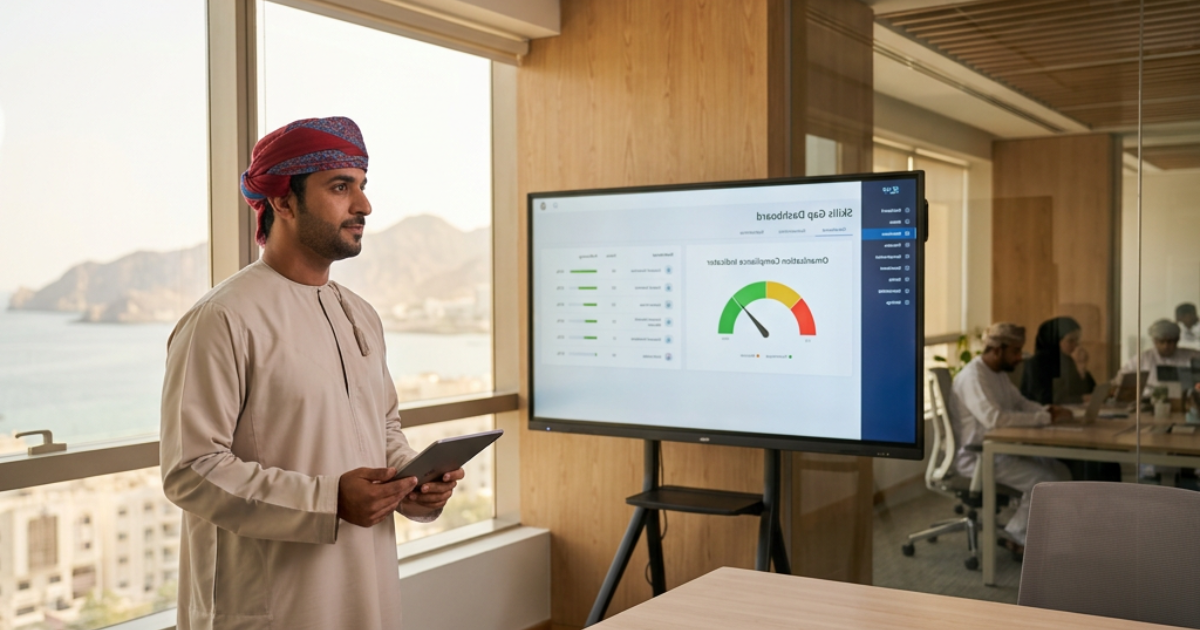
Personalized learning platforms can help identify skill gaps across roles, departments, and locations. If analytics show that a development team systematically struggles with code security, for example, the company can introduce targeted training before the problem begins to affect delivery.
The same information can support longer-term workforce decisions. Instead of discovering a skills shortage only when a new project begins, HR and business leaders can identify capability gaps earlier and decide whether to train existing employees, adjust onboarding programs, support internal mobility, or turn to an agentic AI hiring platform to bring in additional specialists faster
For global teams, this approach is particularly valuable. Training can be adapted to different roles, languages, experience levels, and locations while still supporting a common workforce strategy.
Hire the right candidates faster
Easily collaborate with your team to evaluate candidates, gather feedback, and decide who’s the best fit, with our award-winning recruiting software.
Request a free demoHow Smarter Learning Supports Onboarding and Workforce Development
Implementing modern learning technologies can improve more than the training experience itself. It can give HR and business leaders a clearer picture of workforce readiness and help connect employee development with future business needs.
The main benefits include:
- Faster, more relevant onboarding. New hires can receive training based on their role and existing knowledge instead of completing the same static program as everyone else.
- Less routine administration for HR and training teams. Testing, progress monitoring, and reporting can be automated, leaving more time for workforce planning and employee development.
- Better visibility into workforce skills. Analytics can show where capabilities are strong and where additional training or recruitment may be needed.
- Consistent training across global teams. Companies can deploy onboarding, compliance, and skills programs across locations while adapting content to different roles and languages.
- Training that evolves with workforce needs. Learning materials can be updated as regulations, technologies, job requirements, and business priorities change.
These benefits go beyond employee convenience. They help organizations connect learning investments with hiring, onboarding, internal mobility, and future skills planning.
Choosing a Platform With Workforce Needs in Mind
Before purchasing or developing a learning platform, companies should clearly define the workforce problem they want it to solve. Is the priority faster onboarding, closing specific skills gaps, preparing employees for new roles, or delivering consistent training across multiple locations?
There is little value in choosing a system with a long list of features that employees and managers will never use. The platform should support the organization’s actual workforce priorities.
Integration is equally important. Learning systems should connect with the HR, communication, and workflow tools employees already use. This makes it easier to incorporate learning into onboarding and everyday work rather than treating it as a separate activity.
Companies should also pay close attention to employee privacy and corporate information. Any platform handling workforce data must meet appropriate security and data protection requirements.
A Look Into the Future of Workforce Learning
As AI capabilities develop, the connection between learning and workforce planning is likely to become much stronger. Organizations will increasingly be able to identify emerging skill gaps, personalize onboarding, and prepare existing employees for changing roles before those gaps become urgent hiring problems.
Virtual environments and AI may also make it easier to practice complex tasks safely and provide employees with support while they work rather than only during scheduled training sessions.
The most useful learning platform will therefore not simply be the one with the most AI features. It will be the one that helps employees become productive in their roles, gives managers a clearer view of workforce capabilities, and helps the organization prepare its people for what the business needs next.
Turn top talent to employees fast
Hire, assess, onboard and manage top talent for every job. See how Elevatus streamlines everything; from acquire to new hire.
Request a demoAuthor
Don't miss a thing!
Stay one step ahead. Subscribe and get the latest updates, news, and insights from Elevatus straight to your inbox.